

The construction industry is currently a challenging environment to work in. There are pressures to remain profitable despite increasing prices, the government expects significant housebuilding, yet there are never enough skilled workers. On top of all this, there is also the need to adopt environmentally friendly factors into construction. It’s not surprising that the talk about sustainability surrounds construction, after all, it is one of the UK’s biggest industries which in 2024 saw its fourth year of consecutive growth.
Naturally, such high output comes with a significant environmental footprint, and if we’re serious about hitting net-zero targets, developers need to look beyond design and into the build system itself. One solution could be to look at modern methods of construction, such as Insulated Concrete Formwork (ICF), which uses a polystyrene building block system.
How to assess the environmental impact of your build materials
When reviewing the environmental consequences of a building, it’s easy to focus on one aspect – its energy efficiency. But to truly understand the full scope, we need to zoom out and consider how each construction stage and the building materials chosen impact the environment.
This is where Life Cycle Assessment (LCA) comes in. The methodology analyses the effects of construction throughout every stage, from raw material extraction to end of life. The process is structured around defined life-cycle stages, A-D: the product stage (A1–A3), construction (A4–A5), use (B1–B7), end of life (C1–C4), and any benefits or reuse beyond (D). This breakdown provides a more accurate picture of a material’s full environmental footprint and is widely praised across the sector for its ability to convey the bigger picture of sustainability.

How do building materials impact on environmentally friendly construction
The materials chosen for a build have a huge influence on its environmental performance – not just in use, but across its entire lifecycle. And while no material is perfect, some offer a better balance than others when viewed throughout their whole life.
An insulated solid wall construction method like ICF is a good example for its ability to minimise heating and cooling requirements and building lifespan. Of course, it’s core components are not without criticism. As a system that relies on concrete and polystyrene blocks – both well known for their carbon intensity. For some, this is enough to dismiss it entirely as a sustainable solution.
Of course, looking at one stage of the building process in isolation doesn’t tell the full story. Here’s why, by following the life-cycle stages, we can demonstrate why ICF building solutions are a strong candidate:
Raw Materials and Manufacturing
The raw material extraction, transportation to production sites and manufacturing procedure itself are identified as product stages A1-A3. When assessing ICF blocks as sustainable options for building projects, considering their influence during these phases is key to aligning with EN 15978 and EN 15804 standards.
The structure of ICF is straightforward. Each block consists of two insulating panels, made from either expanded polystyrene insulation (EPS) or Woodcrete, which contains recycled content. Once installed, builders fill them with concrete to create a solid core that delivers superior levels of energy performance. While many critics highlight that a polystyrene building block like EPS comes from fossil fuels and that concrete is carbon-intensive, it’s important to assess each material on its own merits.
Within the UK market, there are two types of ICF blocks. The first is Woodcrete, which mostly uses repurposed wood chips. The second are expanded polystyrene building blocks known as EPS. It’s these second blocks which have the biggest criticism due to their petroleum-based origin, difficulty in recycling and microplastic pollution.
However, industry estimates show that manufacturers use only 0.1% of a barrel of oil to produce polystyrene, yet within the built environment, each litre of oil used in its manufacture can help save up to 200 litres of heating energy over the product’s lifetime. A lot of systems also use a type of EPS which is 100% recyclable, improving the lifecycle sustainability of the polystyrene building block in construction.
The concrete and cement industry has already made huge strides towards a more sustainable future. In comparison to 1990 levels, direct and indirect emissions are down by 53%. The industry has achieved this by driving a number of innovative projects, including fuel switching and developing low carbon concrete. Combining concrete with the ICF blocks can further accelerate this roadmap. For example, when building with ICF, contractors pour concrete into the walls, enclosing it in a way that allows them to further reduce the carbon profile by incorporating other waste materials such as fillers and aggregate.
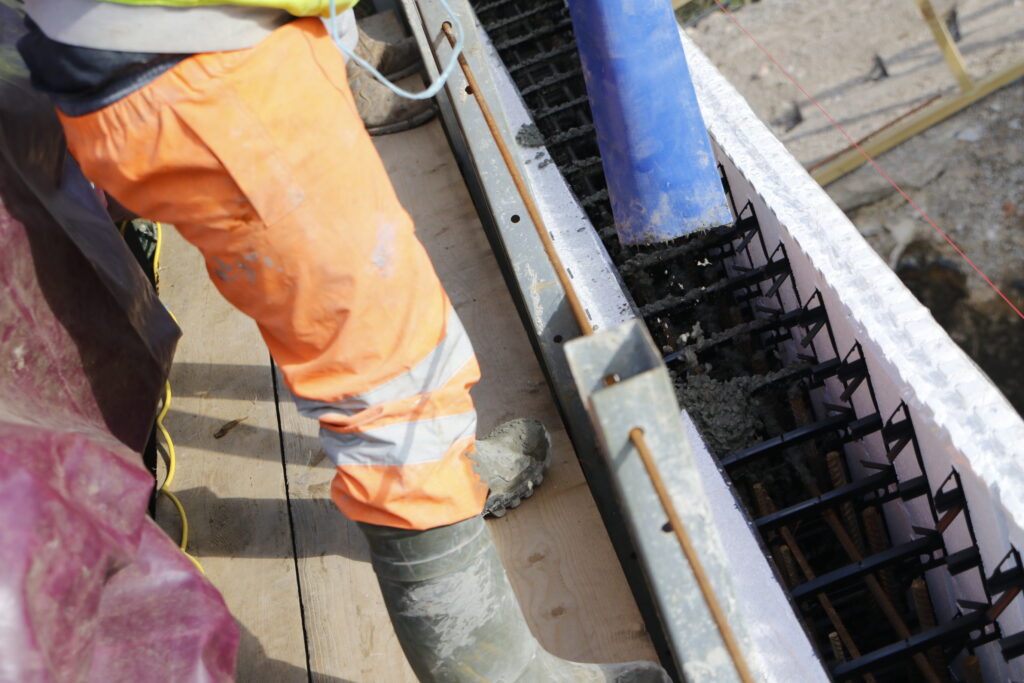
Construction
During site transportation and installation – known as life-cycle stages A4-A5 – ICF delivers clear strengths. Blocks arrive ready to use, meaning there’s significantly less waste, and with a lower material demand, packaging is limited. On a single ICF-constructed build, this enhances the environmental impact of a site, but when scaled across an entire development, the benefits become even more substantial.
There are smaller, frequently overlooked build-stage perks that also contribute to ICF’s low-impact merits. Decreased material requirements result in fewer deliveries and, therefore, minimised logistical emissions. ICF’s interlocking design reduces the need for heavy machinery during installation reducing the amount of emissions produced. Plus, thanks to their compact and easy-to-handle nature, blocks are less prone to damage from handling or weather exposure resulting in less wastage.
ICF’s on-site advantages don’t stop there. Because it’s a quick-to-learn construction method, it typically requires minimal centralised training, which, in the broader context, can cut down the travel-related emissions associated with offsite courses for staff.
In-Use Performance
Use stages B1-B7 are where ICF really shines, and often where its eco credentials are most widely recognised. Chosen as part of a fabric-first strategy, ICF-built properties have optimal airtightness and thermal performance which easily meet passivhaus standards. Not only do they prevent heat from escaping through gaps – which is environmentally beneficial when you factor in the carbon savings from reduced heating requirements – but they also support low-carbon tech. Here, they can decrease the load on heat pumps and enable PV arrays to effectively meet a household’s needs.
This is because ICF helps a property to maintain a stable internal climate. With the thermal insulation and concrete working together, an ICF structure can manage heat gains, minimise overheating and reduce dependence on mechanical heating and cooling systems.
When you consider that 28% of global energy-related carbon emissions come from heating, cooling and powering buildings, and with UK summers growing hotter – with overheating now a major building performance risk – this underscores ICF’s role in driving operational efficiency and weather resistance.
End-of-life and Circularity
Finally, the last phase – stages C1-C4 and D – encompass end of life and circularity. Again, ICF has a case here. A well-designed and properly maintained ICF building solutions can last 100 years or more, and most blocks have some degree of recyclability too. While some are entirely recyclable at the end of their service life, others include components that can be recovered and reused. For example, if built without general reinforcement, it’s possible to repurpose concrete as aggregate. And, in some cases, EPS or Woodcrete can be separated and recycled.

Boosting the environmental credentials of your next build
With the constant pressures on the built environment, it can be challenging for developers and self-builders to find solutions that ease the process. Yet choosing a building material such as ICF can make a significant difference which extends through each stage within the construction process.
Whether it’s how it’s produced, designing energy-efficient Passivhaus standard homes, reducing site waste or offering long-term durability. Yet, as with most build materials, this is only possible if you make the right decisions along every step. Involve one of our ICFA Members early in the build process and they can support throughout the build to make informed and practical environmentally friendly choices that deliver in the real construction environment.
You can read more about how to build with ICF systems by visiting our blog ‘What is ICF construction: the ultimate step by step guide’
For more information on ICF construction, get in touch with the ICFA team today by emailing us on hello@icfa.org.uk.