

The environment is tough for developers. The Labour government has set out bold plans to deliver 1.5 million homes, 14,000 new prison places by 2031, and a targeted overhaul of schools and NHS primary care facilities. Amid ongoing construction industry challenges, from housebuilding targets to the upcoming 10-Year Infrastructure Strategy, which is due for release in June, the ambition is clear:
- Accelerate construction projects
- Modernise infrastructure
- Deliver more homes
Of course, these initiatives present huge opportunities for developers and contractors, however, they could also come with unforeseen problems. Maintaining quality output at a fast enough rate to meet building targets while also juggling the continuous problem of a construction industry skills shortage.
So how can developers and contractors protect and build on their reputation? We take a look at how your choice of build system could provide construction companies with the ideal solution that overcome some of the biggest construction industry challenges.

What are the risks in property development?
There are plenty of key challenges before a developer even gets on site. Not only do you have to go through the lengthy process of get your construction project approved but there are also the additional requirements of meeting tougher regulations. The Part L interim measures, which were introduced a few years ago, require a reduction in CO₂ emissions of 31% for new homes and 27% for new non-domestic buildings. To make the construction industry challenges even more pressing, new measures for the Future Homes Standards 2025 will be announced at some point this year.
Working within a challenging economic environment, once on site, developers need the build keeps within timescales and budget to ensure they remain profitable. None of which is helped by a shortage of skilled tradesman, inclement UK weather, keeping your workforce and site safe and that’s before you consider any issues that might crop up once the build starts. Lastly, construction firms and developers need to reduce problems once the build is complete. Snagging lists can quickly eat into your profits and in this day and age, with negative reviews and posts on social media platforms easily going viral, you don’t need the homeowners to start complaining about quality on your build.
Solving these construction industry challenges is not easy but companies can eliminate many of the problems by choosing a build material like Insulated Concrete Formwork (ICF).

Meeting new energy standards
With the forthcoming release of the Future Homes Standard 2025, the construction industry is expecting for homes to deliver a higher level of energy efficiency and thermal performance. Sustainable practices are a key consideration for projects and meeting these high standards can cause issues for a build.
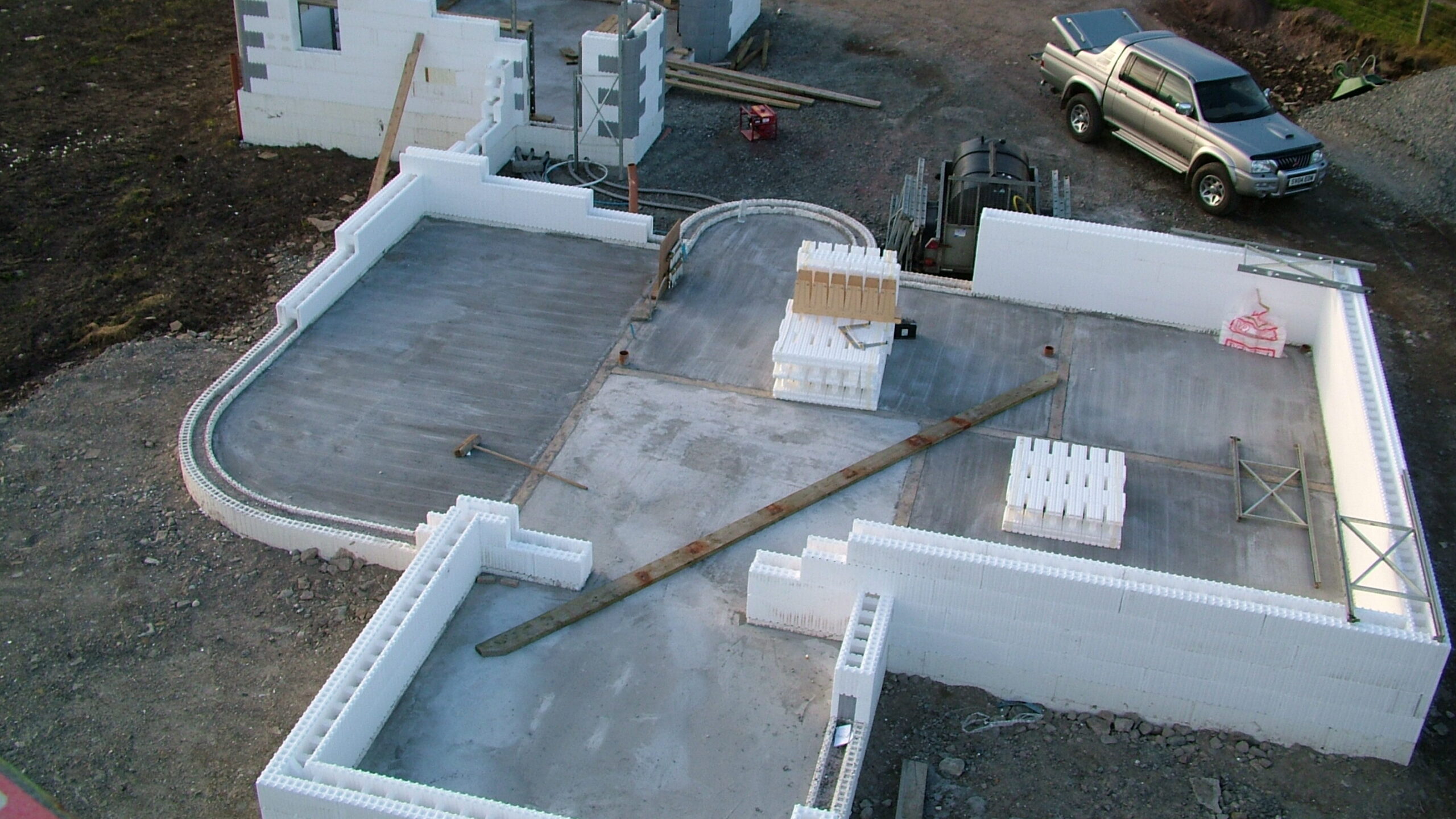
The most logical solution is to take a ‘fabric first’ approach which considers the design and construction of the building envelope to help lower a property’s energy consumption. When building with an insulating formwork such as ICF, the blocks are made from an insulating material, in the UK this is typically either expanded polystyrene (EPS) or woodcrete. Concrete is then poured into a central cavity within the block. Once the concrete has set, the blocks stay in place to provide two layers of insulation that wrap the building.
The figures speak for themselves. An ICF insulating formwork home is capable of meeting, and often exceeding, high performance goals:

Development regulations
Insulation within ICF blocks helps the poured concrete set quickly, allowing it to cure at a controlled pace. This gradual curing process enhances the building’s strength and reduces the risk of cracks, minimising future maintenance needs.
Beyond the logistical and offsite cost savings, ICF buildings continue to deliver long after completion. Their construction ensures a consistent high build quality, meeting – and, in some cases, exceeding – current building standards, while providing end clients with energy-efficient, airtight buildings.
Building with ICF blocks offers a reliable solution that tackles industry challenges, ensures customer satisfaction, and drives business success.
Keeping build costs within budget
When you look at your overall build costs, you need to factor in material costs, labour and equipment.
According to the Building Cost Information Service (BCIS), between December 2023-2024, building material prices for new housing increased by 1.3%. Meanwhile, recent reports point towards labour costs easily climbing by 19% over the next five years. Couple these stats with escalating National Insurance (NI) contributions and a rising National Living Wage hitting employers, and many developers and contractors are not only facing talent gaps but also struggling to retain existing teams, let alone hire and then train new members. In an increasingly expensive and changing landscape, price stability is more crucial than ever to a development’s success. On top of that you need to consider costs associated with transporting materials and plant equipment.
Building with ICF helps manage budgets efficiently. While the initial cost may be higher, savings quickly emerge on-site.
ICF is incredibly simplistic to build with, and you can quickly speed up timescales to reduce onsite construction costs. The ICF system only requires a small number of different materials, which reduces developers’ vulnerability to material cost fluctuations.
As the saying goes, time is money. This is never truer than out on a development. Any delays can quickly eat into profits. Yet, there are other factors which can eat into the affordability of your site including additional costs for plant equipment and transporting materials and unexpected problems during the build.
Projects are reliant on the supply chain. Construction managers need the materials on site, ready for when work begins. Any disruptions in the supply chain disruptions will delay start on site and could end hitting the budget.
ICF doesn’t require pre-manufacturing within a warehouse before delivering to site, constructing the wall doesn’t require bricks that match the local area and ICF material suppliers and manufacturers typically have a ready supply of blocks available to distribute within 48 hours. That means construction activities can get working on site as soon as possible to deliver reliable returns on investment.
The weather – it’s the bane of developers and construction companies alike. October to April contractors often face incessant rain which leaves sites waterlogged, and with climate change creating wetter weather each year, these complications aren’t going away anytime soon. This is before you face the issues caused by frost or even snow.
ICF blocks are made from an insulating material (either EPS or woodcrete) which won’t absorb water like bricks or timber, so there’s no threat of soggy materials slowing things down. This ICF blocks also provide their own superpower when building during the winter months. When constructing the wall there is no need for mortar and instead the blocks fix into place via a raised edge. The insulating property of the blocks also protects the concrete once it has poured enabling it to set quickly but cure very slowly.
Last-minute changes are all too common within the construction industry, frequently causing costly delays and disrupting overall progress. If an issue crops up on site such as foundations not laid correctly, you would typically require extensive rework with traditional fabrication. This not only creates additional expense while new materials are order but also adds to reassigning tasks for the construction workforce which quickly adds expense to the project.
With ICF you have a far more flexible solution. The blocks can be easily cut and adjusted during the build to incorporate alterations to the development and ensure the project stays on track.
Developers and construction workers should also consider the cost savings that can be made in the logistics of the system. The blocks are light in weight and easily stack to greatly reduce the number of deliveries required. For example, on a single build it is possible to deliver the materials on the back of a truck. The lightweight blocks provides another benefit by reducing the amount of plant handling equipment and heavy machinery required on site. Not only does this drive down costs but it also reduces safety concerns on site.

The Skills Shortage
One of the most significant roadblocks to delivering schemes is the acute shortage of skilled workforce. In fact, labour shortages are well-publicised and are one of the main reasons there’s so much doubt cast on the feasibility of Labour’s 1.5 million homes target. Recent articles highlighting that the UK is short of 25,000 bricklayers – one of the very key players in housing delivery. Of course, the skills shortage creates a supply and demand issue. For some trades the demand for skilled workers has driven up wages and resulted in developers having to delay schemes due to a lack of manpower.
Developers need a build solution that relies on fewer skilled workers. Recognised for its simplicity and rapid assembly times, ICF reigns supreme in training new staff and apprentices; whether they’re fresh to the industry or already semi-skilled.
For the construction industry, building with ICF insulating formwork removes the need to apply mortar and instead the blocks fix into place via a raised edge. The process is so simple it is said that even a child could do it! With only a little training, which ICFA members provide, it is possible to overcome the labour shortage problem with apprentices quickly trained to a competent level. What’s more, with the reduction of heavy plant equipment in operation and the blocks moved around site by hand, ICF presents a controlled, low-risk environment.

Insulating Blockwork – Snagging Lists
New homeowners are known for scrutinising every little detail of their shiny new properties, adding plenty of rows to their snagging lists. Research from the National New Homes Customer Satisfaction Survey (covering October 2022 to September 2023) shows that a shocking 95% of new homeowners reported snags or defects after moving in.
To protect your reputation, developers need systems that maximise the quality of the build. It is the simplicity of the system that makes controlling the quality so much easier. To build the wall, the blocks are stacked and interlock tightly via a raised edge with no need for mortar. You then pour concrete into a central cavity. The insulating blocks enables the concrete to set quickly but cure slowly allowing it to gain additional strength with tests showing an ICF insulating blockwork wall is around five times stronger than a concrete block.
The simplicity of the system means it is possible to easily achieve a finished build of an incredibly high standards. With its straightforward assembly, it decreases the likelihood of construction errors, leading to fewer defects and, therefore, shorter snagging lists. As the concrete cures, it sits in direct contact with the blocks to create one homogeneous layer to remove the risks of cracking, unwanted gaps and drafts.
The construction industry is currently facing a major challenge with expectations to deliver housing faster but with a critical shortage of a skilled workforce while also meeting tougher regulations. However, for the construction sector, there are effective solutions if construction businesses are prepared to look at alternative build solutions to deliver on project. If you’d like to find out more, please contact the ICFA by filling in the enquiry form below.