

By Christopher Stride, Chairman, Insulating Concrete Formwork Association (ICFA)
The Future Homes Standard 2026 has landed. After years of consultation, delays, and industry debate, the Government published the Building Circular 01/2026 in March 2026. Issued by the UK Ministry of Housing, Communities and Local Government (MHCLG) the circular letter detailed the new Future Homes and Building Standards with the new regulations coming into force from March 2027.
For those of us who have spent decades working to raise the performance bar in UK housebuilding, it is a moment worth acknowledging even if the picture is more nuanced than the headlines suggest.
The reaction across the construction industry has been predictably mixed.
My view, from the chair of the Insulating Concrete Formwork Association, is straightforward…the Future Homes Standard and amendments to the Building Regulations Approved Documents establish the right destination. How contractors and developers get there is the challenging part.
The good news is that a proven, readily available build system already delivers well beyond what the Standard requires. That system is ICF, and the industry would do well to pay close attention.

The Future Homes Standard 2026: What It Actually Does
Let us be clear about what Building Regulations Part L 2026 delivers. New homes must now be zero-carbon ready. Fossil fuel boilers are effectively prohibited in new-build residential properties. Low-carbon heating systems such as heat pump solutions become the primary heating technology of choice. Solar PV panels are mandated… at minimum covering the equivalent of 40% of the ground floor area on the vast majority of homes.
And the new standard sets a target of reducing carbon emissions by at least 75% compared to 2013 Building Regulations.

Where the Standard Falls Short and Why It Matters
Here is where I will be direct. The Future Homes and Buildings Standard’s relevant industry standards for fabric requirements are, to put it plainly, a missed opportunity.
Despite earlier consultation proposals suggesting significantly tighter U-value targets, the confirmed energy efficiency standards backstop limiting values for external walls remain unchanged from Part L 2021, at 0.26 W/m²K.
The notional specification has tightened, external wall notional U-values move from 0.18 to 0.15 W/m²K – but the minimum standards have not moved.
This matters because the Future Homes Standard 2026 leans heavily on bolt-on technologies – heat pumps, solar PV, mechanical ventilation – to do the work that building fabric should be doing first. These technologies are valuable and they are also expensive to install, dependent on supply chains that are currently under significant pressure, and reliant on homeowners understanding how to operate them correctly. A home, where the energy efficiency requirements perform poorly at the envelope level will always impose a greater burden on its services, regardless of how sophisticated those services are.
RIBA, the Good Homes Alliance and others in the design professions have made this point consistently: fabric efficiency must come first. Improving the thermal performance of the building envelope at the point of construction costs relatively little. Retrofitting it later, adding insulation to walls already clad, re-sealing junctions already built is dramatically more expensive and disruptive. Every home built today with inadequate fabric performance is a future retrofit liability.
The Standard, in its current form, risks locking in that liability at scale, at precisely the moment when the government is pushing to deliver 1.5 million new homes before the end of this Parliament.
Where the Future Homes Standard 2026 Needs to Go
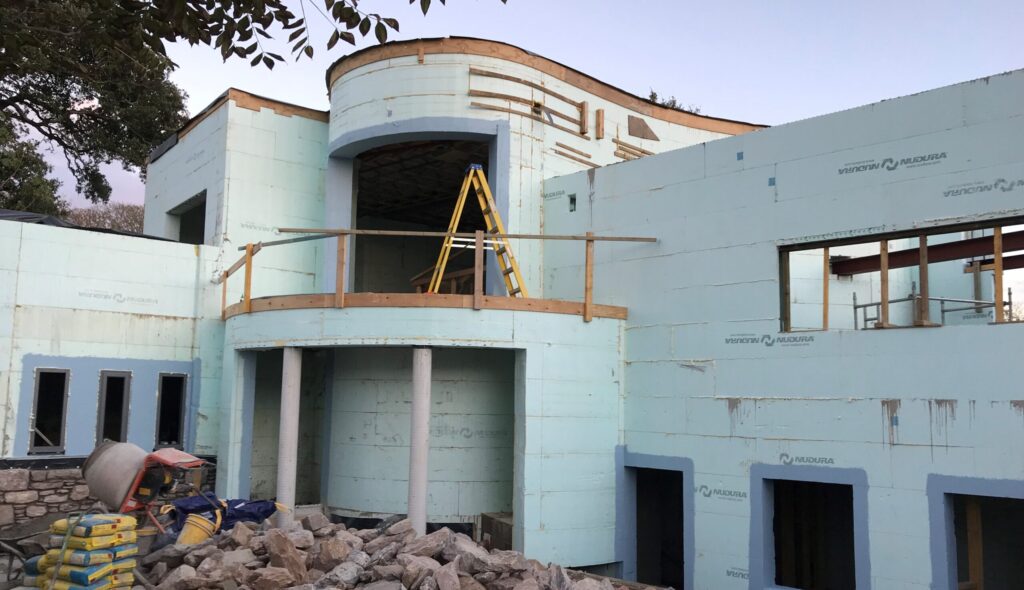
This is where an insulated solid wall construction method like ICF enters the conversation – not as a promotional proposition, but as a technical reality that the industry cannot afford to ignore.
ICF is not a new technology. It has been used across the UK since the 1950s and is well established in North America and across Northern Europe, where cold climates have long demanded a fabric-first approach to building performance.
What makes it particularly relevant right now is that ICF delivers the very performance characteristics that the Future Homes Standard struggles to mandate through its Part L fabric requirements alone. A well-specified ICF wall system routinely achieves U-values of around 0.18 W/m²K at, or better, than the Future Homes Standard 2026 notional buildings specification. The solid concrete core provides both airtightness and structural integrity without relying on every junction perfectly taped on a cold, wet site. It achieves all of this as a matter of course, without requiring additional insulation layers, costly spend, complicated junction details, specialist labour or costly redesigns.
For developers navigating the Future Homes Standard Part L compliance route, this matters in practical terms. A fabric that already significantly reduces carbon emissions and enhances the regulatory benefits to give the design team headroom. It reduces dependency on complex mechanical systems to achieve compliance. It simplifies the energy model. And it means the as-built performance will regulate heating distribution to match the design intent and close the performance gap that has plagued UK housebuilding for decades.
Take a look at what thermal performance levels are achieveable with ICF.
Housebuilding Speed and the 1.5 M Target
There is another dimension to this discussion that I think deserves looking at here, and that is the construction skills crisis. The government’s housebuilding ambitions are laudable.
But the industry is already facing a significant and worsening shortage of skilled tradespeople. Adding the requirement for heat pump installation engineers, MVHR commissioning specialists and solar PV contractors to an already stretched supply chain is a real risk to delivery timescales and build quality alike.
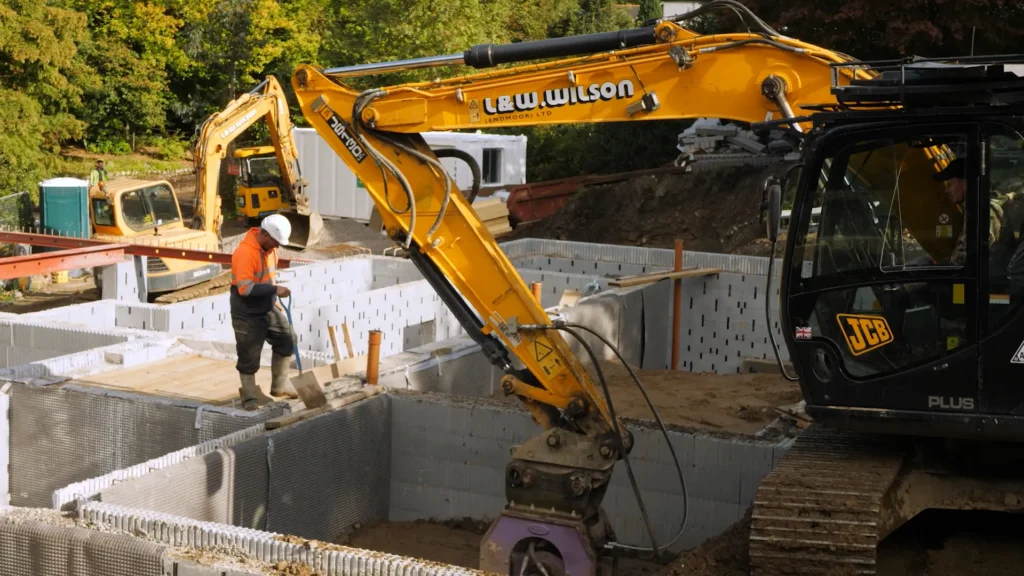
ICF offers a partial but meaningful answer to this challenge. Because blocks interlock without mortar and the system follows a consistent, highly logical construction logic, contractors can reach competency significantly faster than with traditional masonry.
The ICFA requires all member companies to provide training before supplying products to site – this is not a minor procedural point, but a genuine commitment to quality assurance.
In an environment where apprentices and newer entrants to the trades are an increasingly important part of the workforce, a build method that is fast to learn without sacrificing quality has real strategic value. To show a comparison, a standard ground floor wall can be completed in as little as three days and it’s this speed of construction that reduces costs and compresses the build programme. Both are factors that meaningfully affect scheme viability at a time when developers are already absorbing significant additional upfront cost pressures.
Find out how ICF is helping to overcome construction challenges.

The Energy Efficiency Performance Gap Must Be Closed
Perhaps the most important provision in the Future Homes Standard 2026, and one that has received less attention than it deserves is the new requirement under Regulation 40C for homeowners to receive clear, accessible information about how their homes operate.
The government has identified what practitioners have long understood: that a significant proportion of the performance gap in UK housing arises not from design failure, but from homes being used incorrectly because residents were never properly shown how they work.
For an ICF home, this challenge is fundamentally different. The thermal mass and exceptional airtightness of an ICF building create a stable, consistent internal environment that is inherently easier to manage. There are fewer systems to balance, fewer interdependencies to explain, and a greater degree of passive resilience built into the structure itself.
When you consider that the summer of 2025 recorded four separate heatwaves and average temperatures sitting 1.51°C above the long-term meteorological average, understanding how to maximise the effectiveness of a home’s energy efficiency is not a theoretical benefit, it is a lived experience for ICF homeowners.
Interested in how changing weather is affecting how we build out homes – take a look at our blog.

The Future Homes Standard 2026 Transition Window
The 12-month transition period running to March 2027 is now the immediate operational reality for every developer, designer and contractor in England. Schemes with planning applications submitted before March 2027 can continue under Part L 2021, provided they commence before March 2028. But the pipeline of projects entering early design today will be built under the new Standard. The time to understand what compliance looks like, and how to achieve it most effectively, is now, not in 18 months.
My recommendation to any developer, architect or contractor currently navigating that decision is to look seriously at what ICF delivers against the FHS compliance matrix. Not as a novelty or a niche build method, but as a mainstream, common solution that the UK market is long overdue in adopting at scale.
The ICFA exists precisely to support that process: to provide independent, technically rigorous guidance on what ICF delivers and how it can be specified correctly.
The Future Homes Standard 2026 is a step forward. It is not the final word. The industry’s job, our job is to ensure that the homes built under it perform as well as they possibly can, for the people who will live in them and for the net-zero commitments this country has made. ICF is not the only answer but it can make a major difference to the industry.
But it is an answer the industry can use right now, at scale, with confidence.
Christopher Stride is Chairman of the Insulating Concrete Formwork Association (ICFA), the UK trade body representing manufacturers, suppliers and installers of ICF systems. The ICFA provides independent technical guidance on ICF construction for developers, architects, contractors and self-builders.